Frontier AI Won’t Fix Your Security Program If Your Patch Pipeline Is Still Broken
Every few months, cybersecurity finds a new object of obsession.
Right now, that object is frontier AI.
AI agents finding vulnerabilities.
AI models discovering zero-days.
AI-assisted exploit development.
AI red teams.
Cyber-specialized frontier models.
Autonomous vulnerability research.
“Patch the world” narratives.
Board decks full of “AI-driven security transformation.”
And to be clear, this is not fake.
Advanced models are genuinely getting better at reading code, tracing complex logic, identifying vulnerability patterns, generating proof-of-concept ideas, assisting with triage, and even helping with patch development. Google reported that 90 zero-day vulnerabilities were exploited in the wild in 2025, with enterprise technologies accounting for 43 of them, or 48% of the total. That is not a small signal. (TechRadar)
OpenAI, Anthropic, Google, DARPA, and others are all pushing hard into AI-assisted cyber defense. OpenAI’s Daybreak work, for example, explicitly frames the goal as not just finding vulnerabilities, but validating them, understanding impact, building patches, coordinating disclosure, and helping teams deploy fixes. (IT Pro)
So no, the point is not that frontier AI is useless for security.
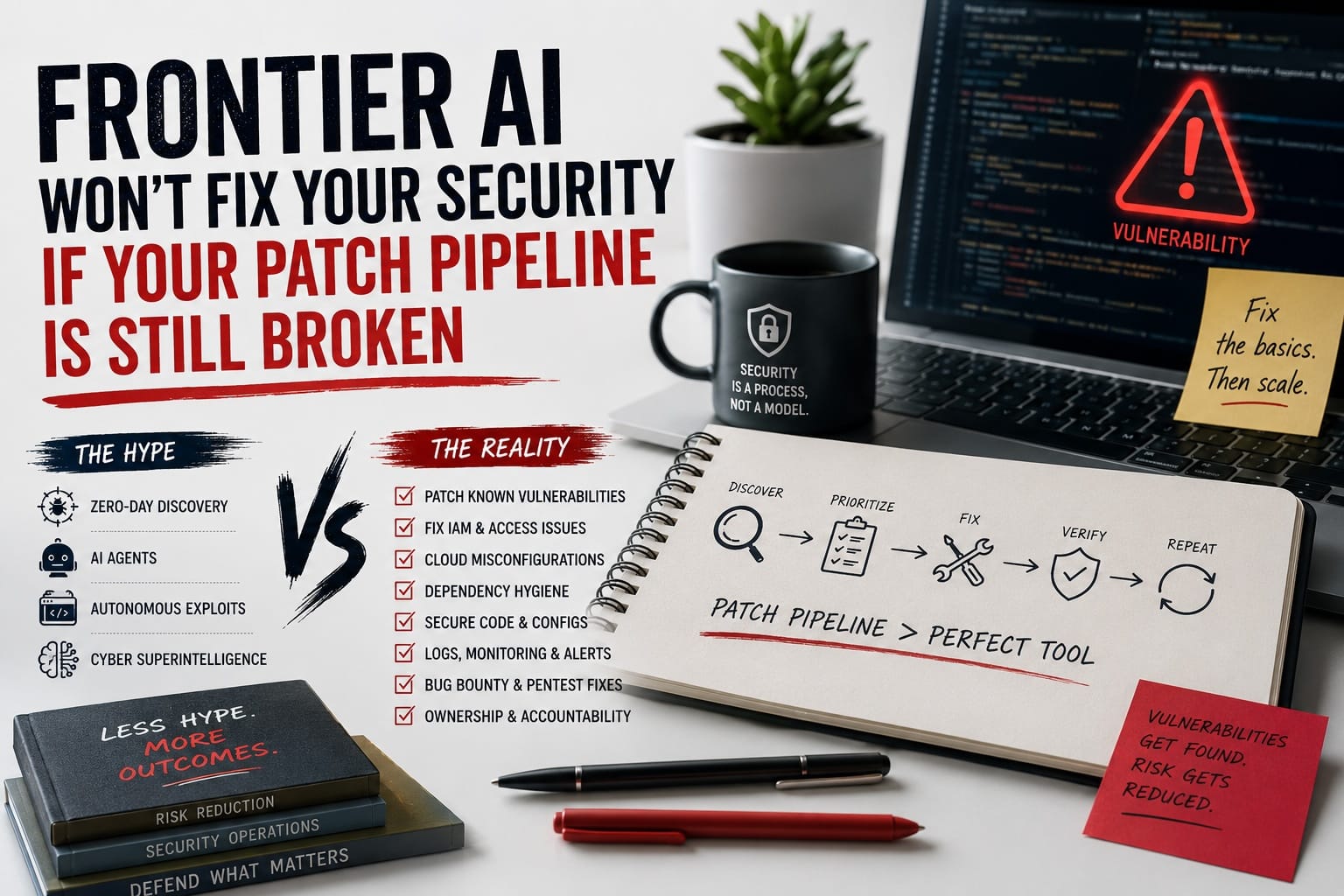
The point is that many organizations are about to misunderstand where the value actually is.
Because for a large number of enterprise, startup, and SaaS security teams, the highest-return problem is not:
“We cannot discover zero-days.”
The actual problem is:
“We cannot fix known issues fast enough.”
That is a very different problem.
And it deserves a very different strategy.
The zero-day story is attractive because it sounds advanced
Zero-days have a special place in cybersecurity culture.
They sound elite.
They sound rare.
They sound board-worthy.
They sound like something only the best offensive researchers, nation-state teams, or frontier AI labs can touch.
So when a vendor says, “Our model can help discover zero-days,” it immediately gets attention.
Security leaders listen.
Investors listen.
Boards listen.
Founders listen.
Practitioners get curious.
Marketing teams get excited.
But the problem with the zero-day narrative is that it can quietly distort priorities.
It makes vulnerability discovery look like the center of the security universe.
In reality, discovery is only one part of the chain.
A vulnerability does not reduce risk just because someone found it.
Risk goes down when the issue is validated, prioritized, assigned to an owner, fixed, tested, deployed, and verified in production.
That is the part most organizations struggle with.
Not the demo.
The pipeline.
Most teams are not building the kind of software where zero-day discovery is their first bottleneck
Let’s be practical.
Is your company building:
- Kernel modules?
- Browsers?
- Hypervisors?
- Protocol parsers?
- Cryptographic libraries?
- Databases?
- Low-level C/C++ runtime components?
- Widely deployed network appliances?
- Security products sitting at the edge of enterprise networks?
- Performance-critical
.sofiles and native libraries? - Infrastructure software used by millions of downstream systems?
If yes, then advanced vulnerability research and AI-assisted zero-day discovery may be strategically important.
You may actually need deeper program analysis, exploitability reasoning, memory-safety research, fuzzing at scale, symbolic execution, model-assisted code review, and serious coordinated disclosure workflows.
But most modern startups, SaaS companies, and enterprise software teams are not operating at that layer.
They are building on top of massive software supply chains.
They use cloud providers.
They use managed databases.
They use open-source libraries.
They use containers.
They use CI/CD platforms.
They use identity providers.
They use SaaS integrations.
They use third-party SDKs.
They use frontend frameworks.
They use package managers.
They use infrastructure-as-code templates.
They use secrets managers, logging systems, queues, APIs, and observability platforms.
Their practical risk is usually not hidden in some cinematic memory corruption bug waiting for a frontier model to uncover it.
Their practical risk is sitting in the higher layers:
- Broken access control
- Overprivileged IAM roles
- Public cloud storage
- Exposed admin interfaces
- Weak tenant isolation
- Hardcoded secrets
- Stale dependencies
- Vulnerable containers
- Missing authorization checks
- Insecure CI/CD workflows
- Leaky APIs
- Poor logging
- Misconfigured identity federation
- Shadow assets nobody owns
- Old pentest findings still marked “accepted risk”
That is the uncomfortable truth.
For many teams, the enemy is not a mysterious zero-day.
The enemy is unresolved security debt.
The data keeps pointing back to boring security
The industry loves advanced threats, but breach data keeps dragging us back to basics.
Mandiant’s M-Trends 2025 reporting showed that exploits were the most common initial infection vector in 2024 at 33%, but stolen credentials and phishing were still major drivers at 16% and 14%. In other words, exploitation matters, but identity, credentials, and access control are still central to real-world compromise. (TechRadar)
Verizon’s 2025 DBIR also reinforces the operational reality. Vulnerability exploitation rose as an initial access vector, but credential abuse remained one of the most common paths into organizations. Verizon also reported that only about 54% of edge-device and VPN vulnerabilities were fully remediated during the year, with a median remediation time of 32 days. (TechRadar)
That matters because edge devices, VPNs, identity systems, and cloud-facing services are not abstract risks. They are the actual doors attackers keep using.
And then there is the software supply chain problem.
Sonatype has repeatedly shown that vulnerable open-source components continue to be downloaded even when fixed versions already exist. Reporting around its 2025 data found that about 13% of global Log4j downloads were still vulnerable years after Log4Shell, and Sonatype noted that around 95% of vulnerable open-source component downloads had a fixed version available. (IT Pro)
That is not a discovery problem.
That is a consumption, ownership, upgrade, and remediation problem.
The fix exists.
The package is available.
The alert has fired.
The dependency scanner has screamed.
The ticket has been created.
And still, the vulnerable version remains in production.
So before buying expensive model access to discover unknown vulnerabilities, many teams should ask a simpler question:
Can we even fix the known ones?
“AI found a zero-day” sounds impressive. “We reduced MTTR by 60%” is more useful.
Security teams often get judged by narratives.
A zero-day story is dramatic.
A model found something unknown.
A report was generated.
A critical severity label was attached.
A board slide was created.
Everyone felt the future arrive.
But a serious security organization should care less about drama and more about risk reduction.
The better story is often less glamorous:
- We reduced mean time to remediate critical vulnerabilities.
- We eliminated long-lived admin permissions.
- We cut dependency upgrade lag from months to days.
- We improved asset inventory accuracy.
- We mapped every critical finding to a service owner.
- We added runtime detection for privilege escalation.
- We closed stale pentest findings.
- We removed hardcoded secrets from CI/CD.
- We implemented guardrails for cloud misconfigurations.
- We stopped accepting “no owner” as a reason for security debt.
That is not sexy.
But that is where security programs mature.
A vulnerability report does not protect anyone by itself. OpenAI’s own Daybreak messaging makes this point clearly: value comes from validating the issue, understanding impact, developing and testing a patch, coordinating disclosure, and helping teams deploy the fix. (IT Pro)
That is the sentence every security leader should pin above their desk.
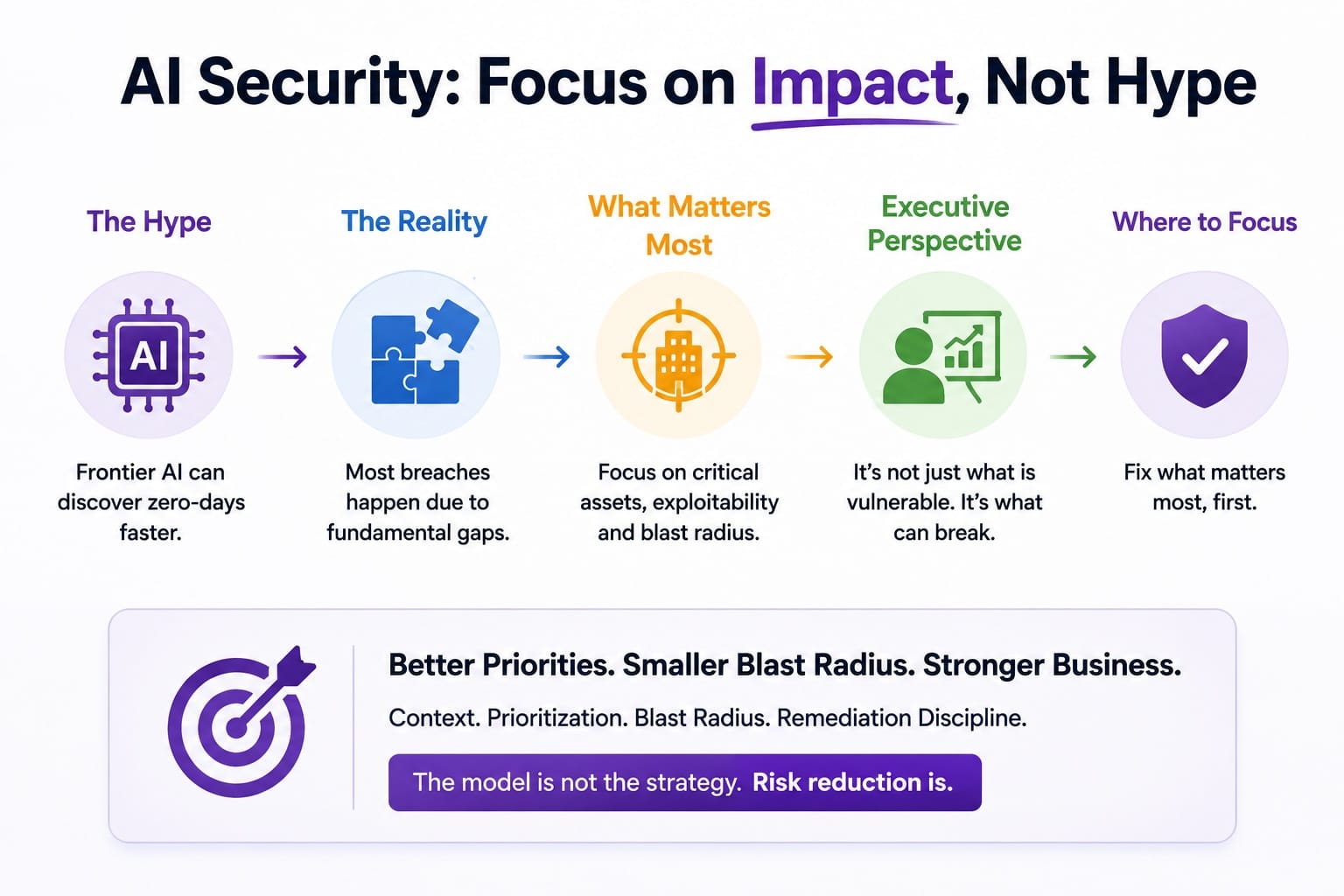
Because the model is not the strategy.
The remediation system is.
The real security bottleneck is not intelligence. It is execution.
Most organizations already have more findings than they can handle.
They have SAST findings.
They have DAST findings.
They have dependency alerts.
They have container scan results.
They have cloud posture alerts.
They have pentest reports.
They have bug bounty submissions.
They have IAM review notes.
They have incident postmortems.
They have audit logs.
They have asset inventories.
They have Jira tickets.
They have Slack threads.
They have risk registers.
The issue is not always a lack of signal.
The issue is that signal does not become action.
Security findings get buried because no one knows who owns the service.
Tickets sit open because engineering teams do not understand exploitability.
Dependency upgrades are delayed because nobody wants to break production.
IAM cleanup is postponed because access reviews are politically annoying.
Cloud misconfigurations are accepted because the team is moving fast.
SAST output is ignored because false positives destroyed trust.
DAST output is ignored because the app team says the endpoint is “internal.”
Bug bounty reports get stuck because triage is slow.
Pentest findings become PDFs that everyone reads once and forgets.
This is where AI can be extremely useful.
But not necessarily as a zero-day oracle.
AI can help connect security work to execution.
It can summarize findings.
It can map vulnerabilities to code owners.
It can generate remediation guidance.
It can explain exploitability to developers.
It can cluster duplicate alerts.
It can draft pull requests.
It can identify dependency upgrade paths.
It can review IAM policies.
It can turn pentest PDFs into actionable tickets.
It can correlate logs with known attack paths.
It can help write detection rules.
It can create executive summaries without hiding technical detail.
That is where AI becomes operational leverage.
Not by replacing the security program.
By making the security program harder to ignore.
Frontier models should be used selectively, not worshipped by default
There are absolutely cases where frontier models make sense.
Use them for deep reasoning.
Use them for complex code analysis.
Use them when context windows matter.
Use them when exploitability reasoning is non-trivial.
Use them for multi-step vulnerability validation.
Use them for patch generation in complex systems.
Use them when the cost of missing the issue is extremely high.
But do not confuse “frontier models are powerful” with “every security workflow needs the most expensive model available.”
A lean team can often get more practical value from a well-designed workflow using smaller models, retrieval, domain-specific context, and targeted automation than from throwing premium tokens at every security problem.
Your historical security artifacts are valuable training and retrieval material:
- Past pentest reports
- Bug bounty submissions
- Resolved incidents
- Cloud misconfiguration history
- IAM review notes
- Dependency alerts
- SAST and DAST findings
- CI/CD security failures
- Audit logs
- Threat models
- Code review comments
- Production incident timelines
This is your environment’s security memory.
A frontier model with no organizational context may sound impressive, but a focused system that understands your architecture, your past bugs, your ownership model, your cloud setup, your recurring mistakes, and your remediation patterns may produce more useful outcomes for day-to-day defense.
The goal is not to use the biggest model.
The goal is to reduce risk.
Those are not always the same thing.
Access friction is also part of the problem
There is another uncomfortable part of the current frontier AI security conversation: access friction.
Some advanced cyber access programs and model verification flows require government-issued identity checks. Some flows reject scans, screenshots, photocopies, or digital versions of IDs. OpenAI and Anthropic documentation both describe identity verification requirements in certain contexts, including physical government-issued ID expectations and restrictions on digital or copied documents. (WIRED)
Now, there are legitimate reasons for stronger access controls around cyber-capable systems.
Nobody serious should pretend otherwise.
If advanced models can materially assist vulnerability discovery or exploitation, then providers will impose governance, verification, monitoring, and access boundaries.
That part is understandable.
But the implementation often feels clumsy, especially for global users.
For Indian users, for example, the practical experience can become absurdly manual: finding Aadhaar or PAN documents, taking physical photos, dealing with rejected digital PDFs, waiting for verification, and repeating steps that could have been smoother through modern digital identity systems.
If a platform wants to serve global defenders, it should not design onboarding as if everyone lives inside one country’s identity assumptions.
A serious cyber access program should answer:
- Why are digital government-backed identity flows not supported where available?
- Why are legitimate researchers forced through high-friction manual checks?
- Why are enterprise users treated like suspicious consumers by default?
- Why is the experience so much worse for non-US users?
- Why does “trusted access” often feel like “expensive access plus identity theater”?
Security access control matters.
But bad onboarding is not governance.
It is friction.
And friction has consequences.
It slows down legitimate defenders.
It favors large organizations with procurement muscle.
It excludes independent researchers.
It frustrates lean security teams.
It creates weird incentives for account sharing and workarounds.
It makes defensive tooling feel less accessible exactly when defenders need speed.
If the goal is to accelerate security work, then access systems need to be secure and usable.
Right now, that balance is not always there.
The boardroom problem: prestige gets funded before plumbing
A lot of security hype survives because it sounds good in boardrooms.
“AI-assisted zero-day discovery” sounds strategic.
“Dependency upgrade automation” sounds boring.
“Autonomous cyber agent” sounds futuristic.
“IAM cleanup workflow” sounds like internal plumbing.
“Frontier model partnership” sounds innovative.
“Reducing stale critical vulnerabilities” sounds like operational hygiene.
But attackers do not care what sounds innovative.
They care what works.
If your external attack surface is poorly tracked, they will find it.
If your VPN is unpatched, they will use it.
If your IAM is overprivileged, they will abuse it.
If your secrets are exposed, they will take them.
If your logging is incomplete, they will hide.
If your dependencies are stale, they will exploit them.
If your cloud is misconfigured, they will walk through it.
If your engineering teams do not own remediation, the backlog will become your attack surface.
This is the real danger of frontier AI hype.
Not that the technology is bad.
The danger is that organizations use the hype to avoid doing difficult, boring, necessary work.
Buying advanced tooling can become a substitute for fixing broken process.
It can make leadership feel like they are investing in security while the actual risk remains untouched.
That is security theater.
With better branding.
A better way to think about AI in security
The right question is not:
“Can this model find a zero-day?”
The better question is:
“Where can AI reduce risk in our security workflow faster than our current process?”
That leads to a much healthier set of use cases.
1. AI for vulnerability prioritization
Most teams are drowning in findings.
AI can help enrich alerts with context:
- Is the asset internet-facing?
- Is the vulnerable package reachable?
- Is exploit code public?
- Is the service business-critical?
- Is there compensating control?
- Has this class of bug appeared before?
- Who owns the service?
- What is the safest upgrade path?
This is more useful than dumping another thousand findings into Jira.
2. AI for remediation guidance
Developers do not need vague security tickets.
They need clear fixes.
AI can help convert security findings into engineering-ready tasks:
- What file is affected?
- What package needs upgrading?
- What code path is vulnerable?
- What test should be added?
- What behavior should change?
- What migration risk exists?
- What pull request template should be used?
The more specific the remediation, the more likely it ships.
3. AI for IAM and cloud review
Cloud and identity systems are full of subtle risk.
AI can help review:
- IAM policies
- Trust relationships
- Overbroad roles
- Public buckets
- Security group exposure
- Unused permissions
- Risky service accounts
- CI/CD deployment permissions
- Cross-account access paths
This is not glamorous zero-day research.
But it can prevent very real compromise.
4. AI for pentest and bug bounty triage
Many teams already receive useful external reports.
The bottleneck is triage.
AI can help:
- Deduplicate reports
- Summarize impact
- Reproduce steps
- Identify affected components
- Draft developer-facing explanations
- Compare reports against past findings
- Recommend severity adjustments
- Generate customer-safe language
This helps security teams move faster without pretending every finding is novel research.
5. AI for detection engineering
AI can help defenders write and refine:
- Sigma rules
- YARA rules
- SIEM queries
- EDR hunting queries
- Cloud detection logic
- Alert descriptions
- Investigation playbooks
- Incident timelines
This is especially useful for lean teams that do not have endless detection engineering capacity.
6. AI for security knowledge management
Most organizations forget their own security history.
AI can help build institutional memory from:
- Incidents
- Postmortems
- Pentests
- Audit findings
- Bug bounty reports
- Architecture reviews
- Threat models
- Previous remediation decisions
This matters because repeat bugs are common.
A team that learns from its own history becomes harder to compromise.
What teams should fix before chasing zero-day AI
Before spending heavily on frontier-model-based zero-day discovery, a security leader should be able to answer these questions.
Asset ownership
Do we know every internet-facing asset?
Do we know which team owns each one?
Do we know which assets process sensitive data?
Can we identify abandoned services?
Can we tell whether a vulnerable service is still in use?
Vulnerability management
Can we patch critical vulnerabilities within SLA?
Do we measure mean time to remediate?
Do we know which vulnerabilities are reachable?
Can we distinguish theoretical findings from exploitable ones?
Do we track exceptions and risk acceptance properly?
Dependency hygiene
Do we know which open-source packages are in production?
Can we upgrade critical dependencies quickly?
Do we understand transitive dependency risk?
Do we generate and use SBOMs meaningfully?
Do we block known vulnerable packages in CI/CD?
Identity and access
Do we review privileged access regularly?
Do we remove unused permissions?
Do we enforce least privilege?
Do we monitor privilege escalation?
Do we understand cloud trust relationships?
Do we detect suspicious service account behavior?
Cloud posture
Do we continuously monitor misconfigurations?
Do we prevent public exposure by default?
Do we enforce secure infrastructure-as-code patterns?
Do we detect drift from approved baselines?
Do we log control-plane activity?
Do we review risky cloud changes before production?
AppSec basics
Do we test authorization properly?
Do we catch broken access control?
Do we review tenant isolation?
Do we test APIs, not just UI flows?
Do we use SAST and DAST output effectively?
Do developers trust security tooling?
Logging and detection
Do we have logs for critical systems?
Are logs centralized and searchable?
Can we detect suspicious authentication behavior?
Can we reconstruct incidents?
Do we alert on meaningful behavior or just noise?
Can we investigate without asking engineering to manually grep servers?
Remediation workflow
Does every finding have an owner?
Do security tickets include enough context?
Do engineering teams understand impact?
Are fixes verified after deployment?
Do we track reopened or recurring findings?
Do unresolved findings age forever?
If the answer to many of these questions is “no,” then zero-day discovery is probably not your first problem.
Your first problem is security operations maturity.
The uncomfortable truth about “AI-discovered vulnerabilities”
There is also a subtle marketing issue here.
When a model finds a vulnerability in a dependency, an upstream open-source project, or a widely used external component, the finding may be real and important.
But what does your organization actually control?
Sometimes you can upgrade.
Sometimes you can mitigate.
Sometimes you can open a pull request.
Sometimes you can wait for maintainers.
Sometimes you can fork.
Sometimes you can disable a feature.
Sometimes you can isolate the component.
Sometimes you can only document the exposure and monitor.
That means the value of discovery depends heavily on the remediation path.
A finding with no practical fix path may be useful intelligence, but it is not the same as reduced risk.
This is why mature security teams care about exploitability, reachability, ownership, business impact, and remediation feasibility.
A hundred “critical” findings do not automatically make you safer.
One critical fix deployed correctly might.
AI security strategy should start from the backlog, not the benchmark
Many organizations approach AI security tooling backwards.
They start with model capability:
- Which model is most powerful?
- Which model scores best?
- Which model can find deeper bugs?
- Which model has the most impressive demo?
- Which vendor has the strongest cyber narrative?
That is interesting, but incomplete.
A better approach starts with your backlog:
- Where are findings stuck?
- Which teams are overloaded?
- Which alerts are ignored?
- Which vulnerabilities repeat?
- Which fixes take too long?
- Which assets lack owners?
- Which controls are manually reviewed?
- Which reports are never converted into action?
- Which security tasks are high-volume and low-context?
- Which decisions require better summarization or correlation?
Then ask where AI can remove friction.
That is how AI becomes a security multiplier.
Not by chasing the most advanced possible use case.
By accelerating the most painful recurring workflow.
A realistic AI security roadmap for lean teams
For a lean security team, I would think about AI adoption in phases.
Phase 1: Make existing findings usable
Start with what you already have.
Use AI to summarize and normalize:
- Pentest reports
- Bug bounty reports
- SAST findings
- DAST findings
- Dependency alerts
- Cloud posture findings
- Incident postmortems
Turn messy documents into structured security work.
Output should include:
- Summary
- Severity
- Affected asset
- Owner
- Evidence
- Exploitability
- Business impact
- Recommended fix
- Validation steps
- Suggested ticket text
This alone can save serious time.
Phase 2: Add organizational context
Connect findings to:
- Asset inventory
- Service ownership
- Code repositories
- Deployment environments
- Cloud accounts
- IAM roles
- Historical incidents
- Previous vulnerabilities
- Existing compensating controls
This is where AI becomes much more useful.
A generic model says, “Upgrade package X.”
A context-aware workflow says, “Package X is used in this service, owned by this team, deployed in this environment, exposed through this endpoint, and upgrade path Y is safest because previous incident Z showed breaking behavior in version A.”
That is a different level of usefulness.
Phase 3: Generate remediation support
Use AI to draft:
- Pull requests
- Config changes
- IAM policy reductions
- Test cases
- Developer explanations
- Migration notes
- Rollback plans
- Detection logic
- Customer-safe summaries
Do not blindly auto-merge.
But do reduce the manual work needed to get a fix moving.
Phase 4: Add validation
Use AI-assisted workflows to verify:
- Was the vulnerable package removed?
- Was the endpoint protected?
- Was the IAM permission actually reduced?
- Was the secret rotated?
- Was the detection rule deployed?
- Was the finding closed correctly?
- Did the fix introduce regression risk?
This closes the loop.
Security value comes from closed loops.
Phase 5: Use frontier models for deep cases
Once the basics are working, then use frontier models for the hard problems:
- Complex exploitability reasoning
- Large codebase review
- Vulnerability variant analysis
- Patch quality review
- Protocol-level analysis
- Advanced fuzzing workflows
- High-impact open-source dependency review
- Critical infrastructure exposure
- Coordinated disclosure support
At that point, frontier AI is not theater.
It is targeted capability.
The problem is not AI hype. The problem is lazy adoption.
I am not against frontier AI in cybersecurity.
I am against using frontier AI as a status symbol.
There is a difference.
Good use of AI:
“We reduced remediation time for critical findings by 40%.”
Bad use of AI:
“We bought access to a cyber model and now we are innovative.”
Good use of AI:
“We used model-assisted triage to cut duplicate bug bounty noise.”
Bad use of AI:
“We asked the model to find zero-days because it sounds impressive.”
Good use of AI:
“We connected cloud findings to service owners and generated fix-ready tickets.”
Bad use of AI:
“We ran an expensive model over random code and produced a scary report.”
Good use of AI:
“We use frontier models for high-impact code paths and smaller workflows for routine security operations.”
Bad use of AI:
“Every security task now goes through the most expensive model because leadership likes the word frontier.”
The distinction matters.
AI can absolutely make security better.
But only when it is attached to a real operating model.
The security industry needs less prestige buying and more outcome thinking
Every security trend creates the same cycle.
A real capability appears.
Vendors package it.
Investors amplify it.
Executives notice it.
Teams are asked to adopt it.
The first wave of adoption focuses on visibility and optics.
The hard operational work comes later, if it comes at all.
We saw this with threat intelligence.
We saw this with EDR.
We saw this with XDR.
We saw this with CNAPP.
We saw this with SBOMs.
We saw this with bug bounty.
We saw this with AI copilots.
Now we are seeing it with frontier AI for security.
The capability is real.
The hype is also real.
Both can be true.
The question is not whether AI will change security. It already is.
The question is whether your organization will use AI to reduce actual risk or simply to produce better-looking security theater.
The board should ask better questions
If a security team proposes frontier AI investment, the board should not only ask:
“Can it find vulnerabilities?”
They should ask:
- Which risk does this reduce?
- Which workflow does this accelerate?
- What is our current baseline?
- How will we measure improvement?
- Does this reduce mean time to remediate?
- Does this improve patch adoption?
- Does this reduce identity risk?
- Does this improve cloud posture?
- Does this help engineering ship fixes?
- Does this reduce alert fatigue?
- Does this create more findings than we can handle?
- What happens after the model finds something?
- Who owns the fix?
- How do we verify the fix landed?
That last question is the most important.
What happens after the model finds something?
If the answer is unclear, the investment is premature.
The better mantra: patch pipelines over prestige models
For most organizations, the order of operations should be:
- Know what you own.
- Know what is exposed.
- Know what is vulnerable.
- Know who owns the fix.
- Fix critical issues quickly.
- Verify fixes in production.
- Learn from recurring failure patterns.
- Use AI to accelerate all of the above.
- Use frontier models selectively for genuinely hard cases.
Not:
- Buy frontier model access.
- Run impressive demo.
- Generate scary findings.
- Add more tickets to an already broken backlog.
- Tell the board you are now AI-native.
That is backwards.
Final take
Frontier AI for security is real.
Zero-day discovery matters.
Advanced models will absolutely change vulnerability research, exploit analysis, patch generation, and defensive automation.
But many organizations are not failing because they lack access to a model that can discover unknown bugs.
They are failing because known bugs remain unfixed.
They are failing because IAM is messy.
They are failing because cloud posture is inconsistent.
They are failing because dependency upgrades are slow.
They are failing because CI/CD security is weak.
They are failing because logs are incomplete.
They are failing because ownership is unclear.
They are failing because security findings do not become shipped fixes.
So yes, experiment with frontier AI.
Use it where the reasoning depth matters.
Use it where the risk justifies the cost.
Use it where the workflow is mature enough to absorb the output.
But do not confuse model access with security maturity.
Do not confuse vulnerability discovery with risk reduction.
Do not confuse a board-friendly AI story with a functioning remediation engine.
The model is not the strategy.
The patch pipeline is.
The access review is.
The cloud baseline is.
The dependency upgrade is.
The bug bounty triage process is.
The fix that actually ships is.
That is where security gets better.
Not in the demo.
Not in the press release.
Not in the “AI found a zero-day” headline.
In production.
After the fix lands.